

Q and A with Kiwibot Employee Nicolás David Ávila-Rey
- Sofia Langlois
- Nov 16, 2023
- 3 min read

Updated: May 6
Kiwibot navigating harsh weather. Videos courtesy of Ávila-Rey
Q: What is your job title?
A: Operations Analyst and Junior Maintenance Engineer
Q: Are you employed by Sodexo, UMaine, or a separate company?
A: I am employed by Kiwibot. Thanks to a partnership with Sodexo, we are able to provide dining services at UMaine and other 29 Campuses around the US.
Q: Which skills in particular are necessary to possess in your line of work?
A: My role demands technical expertise, stemming from my academic background as an engineer and training provided by Kiwibot's HR, Maintenance and Hardware team. Additionally, working in a startup like Kiwibot requires adaptability due to the fast-paced nature of the industry and the constant drive for improvement.
Q: How long have you been involved in robotics/ software engineering?
A: Since I was very young, the field of robotics has caught my attention. During my career, I embarked on different projects and independent works, and finally landed at Kiwibot, working directly with the fleet of last mile bots you can see now going around the campus.
Q: Did you take part in the development of the KiwiBots or in any current programming?
A: For the current designs, I have not had the opportunity to collaborate directly. However, since everything is a constant iteration, the design team collects feedback from all areas of the company and from the people who interact with the bots. This includes, of course, the community present on the campuses or areas where Kiwibot operates.
Q: How many of the robots are on-campus as of now?
A: Currently, there are 20 robots on campus. Presently, they are serving Bear's Den, and we plan to expand to York and Hilltop dinings later in the semester.

Two Kiwibots infront of the Memorial Union
Q: What measures have been taken in order to avoid damage or thievery?
A: The community at the university is usually very responsible. Additionally, the streets within the campus are designed to be easily accessible for people with disabilities and wheelchairs, which allows the Kiwibot to move around without any difficulty. In case of any potential danger or vandalism, the bot can immediately send out a panic signal that is monitored by our remote supervisors and field team. Furthermore, we have the support of the campus police to handle more severe situations.
Q: What is it that makes KiwiBots capable of maneuvering around students and staff on such an active campus?
A: Today, our robots have a level five of autonomy. Its system is capable of being self-sufficient in most of its operations to reach the pre-established destination while solving problems in various scenarios: walking along the sidewalk, staying focused on the sidewalk, avoiding colliding with objects, people and animals; identifying street crossings, knowing if it is safe to cross and crossing the street.
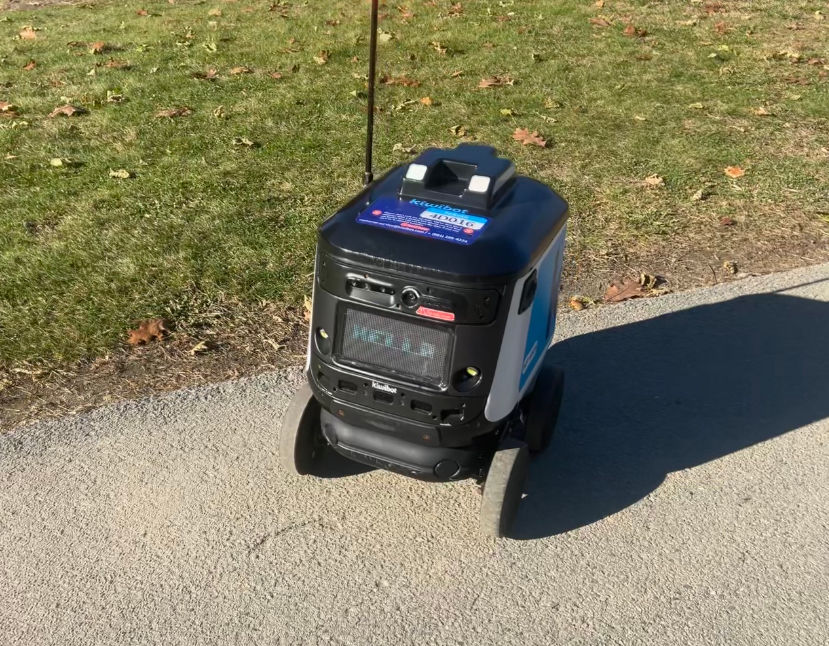
Kiwibot displaying "HELLO" message
The Kiwibots can accomplish most of their tasks autonomously and need supervision only for very specific, high-risk moments. For us, safety always prevails over efficiency. When we carry out technology developments, we always take efficiency into account, but pedestrians’ safety is our priority.
Kiwibot's high-driving automation robots use a combination of sensors and artificial intelligence to navigate through surroundings and obstacles. It also utilizes an advanced GPS navigation system with a high-tech satellite solution, to generate virtual maps and establish multiple routes that make it possible to reach a pre-defined goal.
Q: Will these services still be available come wintertime? If so, how will they navigate harsh weather conditions?
A: Our aim is to continue operating in winter. Several projects have successfully tested special tires and accessories on snowy campuses. However, given the unique conditions of UMaine's northern campus, we will evaluate bot performance and adapt as needed.
In principle the Kiwibots can operate in winter, with snow and on rainy days. They are manufactured to cope with difficult weather and snow conditions. Their hardware is designed and tested to handle extreme weather.
Kiwibot active amidst snow storm
Q: Do you predict a potential expansion for this technology that goes beyond food delivery?
A: Like any new concept, we must start with a specific niche, in this case food delivery. Now, we are totally open to new ideas and despite the great challenges ahead, Kiwibot's philosophy is to make robotics a visible and complementary part of our lives, not as a threat but as a tool for improving our daily experiences and quality of life.


Comments