top of page

About Info:

My name is Sofia Langlois. I am a student of Journalism at UMO with a strong interest in news writing. I work as Editor-in-Chief of  https://mainecampus.com/    

IMG_5854.jpg
Search

ree

Ritchie stood infront of a chalkboard with Holocaust research initiatives written. Photo courtesy of Ritchie.


Katie Ritchie is a fourth-year student of history and education. She is a research assistant who does data entry on the Holocaust for Dr. Anne Knowles, a prominent historical geographer and professor at the University of Maine. 


Ritchie contributes to Knowles’ larger project, which started in 2007 at Middlebury College, by reading written accounts from WWII. She then uses that information to find geographic coordinates which pinpoint the precise location of concentration camps that were once active. 


“The most rewarding part of my job has been the opportunity to dip my feet into academic history,” Ritchie said.


She started at UMaine as a secondary education major, then decided to expand her studies to history halfway through. She intends to pursue a masters degree and teach at a collegiate level. It was nearly two years ago that Richie was offered a position with Knowles. 


One of the main benefits of her job is that it is fully remote. She is able to choose her schedule and is currently contracted to work five hours each week. That number depends on the amount of funding received by Knowles and has also been between 10 and 20 hours. Data entry can be completed anywhere at any time of day. 


Knowles’ project is called “Placing the Holocaust” and has been ongoing for over a decade. The wider objective is to create a database about camps and ghettos using Geographic Information Systems (GIS). By establishing a map that people can interact with, certain details can be accessed by anyone interested in the subject. 


“Say you want to find camps that were open from 1941 to 1945 that had only women in them. You can type that into this database and it’ll pop up. The work that I’ve been doing is going in and getting the data and entering it so when somebody wants to find it, it’s all right there,” said Ritchie. 


“Placing the Holocaust” also makes direct contributions to the United States Holocaust Memorial Museum with its beta version of their database. Recently, a workshop in Prague allowed researchers to share new discoveries relating to this line of work. 


Richie also shared that it is important to be objective because focusing on tragedies can take a toll on one’s mental health. She explained that as a sensitive person, one way for her to devote time to “emotionally overwhelming” work is by avoiding consumption of Holocaust media. 


“I remember when Ukraine was first happening, we were all kind of sitting there trying to figure out how to register all of it, while also studying the Holocaust and hearing and seeing the things that people are saying was really difficult,” Ritchie said.


Luckily, the flexibility of her job allows Ritchie to take two or three week breaks when necessary. She is able to step away and register some of the information before coming back to it. She also feels that her efforts are compensated fairly, as the hourly rate is more than minimum wage.


“I am just so grateful to get paid at all for it. I know professors who are working on this project, doing data entry for free because it’s fun for them. So, I’m grateful that I am getting paid for it and I am just so happy to be a part of it,” said Ritchie. 


She is also working on an exciting fellowship project. Ritchie received scholarship funding to create physical, woodcut maps using data from “Placing the Holocaust.” Every history student studies history. Ritchie, through her employment with Knowles, is actually contributing to it by helping establish a database that will be referenced for years to come. 


An early map created by Knowles can be accessed here.


Updated: May 17, 2024


ree

Cleary-Reuning seated in her office at WMEB headquarters in the Memorial Union


Jess Cleary-Reuning is employed at WMEB, a student-run radio station, as the Station Manager. She is currently overseeing the transition into an all-encompassing broadcast organization. Her main role is to serve as a driving force for getting things done and choosing which direction to go in.


“It’s been really great to put a lot of energy into building a space for community and creativity and then to watch community and creativity kind of play itself out in that space. It’s been my favorite part,” said Cleary-Reuning.


Cleary-Reuning is also responsible for planning out the schedule each semester, running weekly staff meetings and conducting one-on-ones with the six other positions. They set goals together for the semester and she works closely to help everything get accomplished.


ree

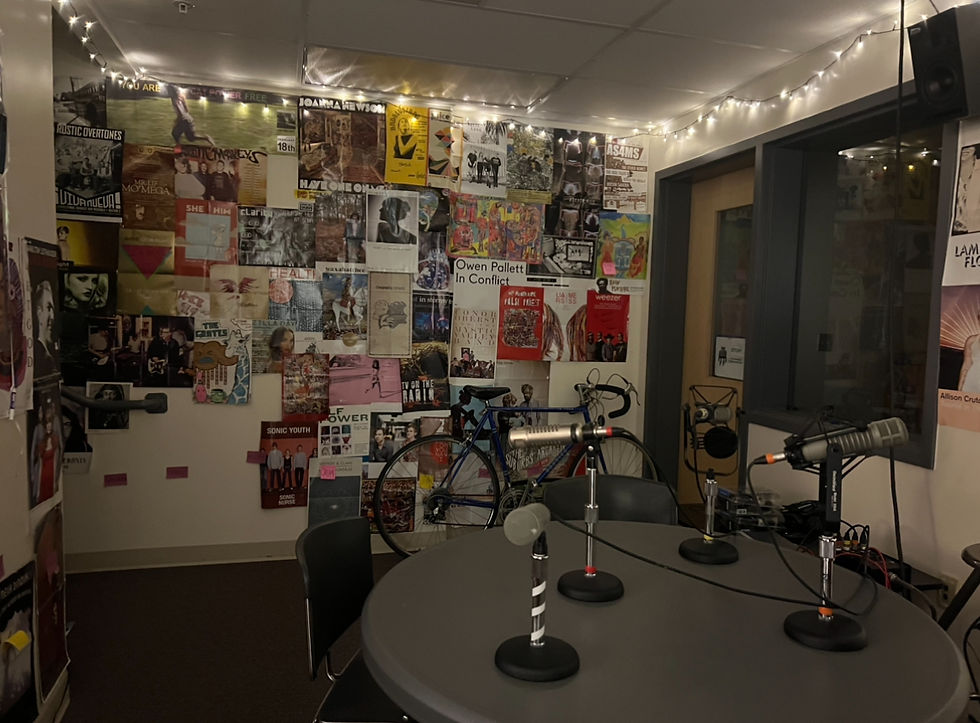
Recording station at WMEB


“I originally was hired as the program director in March of 2022, the spring semester of my sophomore year. But there was not much going on here… There were three staff members, but they were all graduating in a month, there were no DJs. Then I quickly was promoted, technically, to a station manager and started hiring a group of students,” Cleary-Reuning said.


Cleary-Reuning runs a show previously titled “Jettfuel” every Thursday from 9 a.m. to 11 a.m. The name was derived from a nickname sophomore year, as Jett sounds similar to Jess. However, her show is undergoing a revamp and is now called “The Mystic Brew,” based on a jazz fusion song by Ronnie Foster.


“When I first started at the radio station, I had no broadcast experience. I’ve always liked music and I’ve always loved listening to different types of music, but it’s always been really scary… I wasn’t very comfortable doing my radio show at first but then a semester into my job, I was like ‘how can I lead a radio station if I’m not doing the main thing that we’re focusing on’?” said Cleary-Reuning.


“Jettfuel” was was initially two hours worth of Cleary-Reuning’s song choices. With the name change, she is falling into more of a rapport with the audience and able to expand the schedule. Every other week, she will be welcoming a leader of different organizations on campus to speak on their experiences. It will serve as a window into all kinds of roles in the UMaine community, which would be specifically useful for incoming students seeking to learn about campus goings-on.


One of the first guests will be President of UMaine Student Government Michael Delorge. On the off weeks, she intends to provide media reviews on top of her typical streaming of music. Cleary-Reuning will be giving her two cents on various books, tv shows, movies, concerts and events that she has experienced. She considers this sharing of thoughts to be her “mystic brew” and the interviews a “mystic brew” for the campus.


When asked what sort of attributes Cleary-Reuning looks for when hiring newcomers, she explained how initially WMEB had such a small social media presence, that the first two positions had only one interview each. However, in recent months, they had to hire for a position with upwards of 20 applicants, after the student body showed a strong interest at the involvement fair this fall.


“One of the big things I look for when hiring is controlled ambition. I want someone to be able to do things and have passion for the radio station, and drive themselves to do what they need to get done. But I want it to be in their position, if that makes sense. They can go, but they’re not doing other people’s jobs. Understanding their position and where they stand and what they need to do to help everyone work,” Cleary-Reuning said.


Cleary-Reuning spends a great deal of time in the WMEB office, located in the basement of the union. Staff members hold three office hours per week and hers are every Monday from noon to 1 p.m. as well as Tuesdays and Thurdsays from 12:30 p.m. to 1:30 p.m. With her show, weekly staff meetings and check-ins, Cleary-Reuning frequently hangs out in her office in between those obligations. There is a coffee maker, a refrigerator to store lunch and an excellent community established for company throughout her day.


ree

Hayden Buzzel and Benji Kuebler seated in WMEB common area


“I really appreciated watching the station community come together over the last two years. Like I said, when I started here, there was minimal staff, minimal on-air presence and you would come in here and… nothing. There would just be a robo-DJ playing music, you wouldn’t see a soul,” said Cleary-Reuning.


When asked about continuing in the field of broadcast media, Cleary- Reuning shared that she has declared a minor in journalism and that her current thesis revolves around media studies and media history. She is researching the role of radio in the past, present and future.


“Providing a place for people to speak their minds and share what they think is really important as well as communicating information to people is some of the most important things that can be done within a community. So, I am focusing more in that direction with my future,” Cleary-Reuning said.


ree

Bulletin board with radio station history documents


Lastly, she emphasizes that anyone can access WMEB programming through the local channel 91.9 FM.


“You should tune in! It’s an FM radio but we also have a stream link on our website so you can listen on your computer or your phone. And follow us on instagram,” said Cleary-Reuning.


Kiwibot navigating harsh weather. Videos courtesy of Ávila-Rey


Q: What is your job title?


A: Operations Analyst and Junior Maintenance Engineer


Q: Are you employed by Sodexo, UMaine, or a separate company?


A: I am employed by Kiwibot. Thanks to a partnership with Sodexo, we are able to provide dining services at UMaine and other 29 Campuses around the US.


Q: Which skills in particular are necessary to possess in your line of work?


A: My role demands technical expertise, stemming from my academic background as an engineer and training provided by Kiwibot's HR, Maintenance and Hardware team. Additionally, working in a startup like Kiwibot requires adaptability due to the fast-paced nature of the industry and the constant drive for improvement.


Q: How long have you been involved in robotics/ software engineering?


A: Since I was very young, the field of robotics has caught my attention. During my career, I embarked on different projects and independent works, and finally landed at Kiwibot, working directly with the fleet of last mile bots you can see now going around the campus.


Q: Did you take part in the development of the KiwiBots or in any current programming?


A: For the current designs, I have not had the opportunity to collaborate directly. However, since everything is a constant iteration, the design team collects feedback from all areas of the company and from the people who interact with the bots. This includes, of course, the community present on the campuses or areas where Kiwibot operates.


Q: How many of the robots are on-campus as of now?


A: Currently, there are 20 robots on campus. Presently, they are serving Bear's Den, and we plan to expand to York and Hilltop dinings later in the semester.


ree

Two Kiwibots infront of the Memorial Union


Q: What measures have been taken in order to avoid damage or thievery?


A: The community at the university is usually very responsible. Additionally, the streets within the campus are designed to be easily accessible for people with disabilities and wheelchairs, which allows the Kiwibot to move around without any difficulty. In case of any potential danger or vandalism, the bot can immediately send out a panic signal that is monitored by our remote supervisors and field team. Furthermore, we have the support of the campus police to handle more severe situations.


Q: What is it that makes KiwiBots capable of maneuvering around students and staff on such an active campus?


A: Today, our robots have a level five of autonomy. Its system is capable of being self-sufficient in most of its operations to reach the pre-established destination while solving problems in various scenarios: walking along the sidewalk, staying focused on the sidewalk, avoiding colliding with objects, people and animals; identifying street crossings, knowing if it is safe to cross and crossing the street.


ree

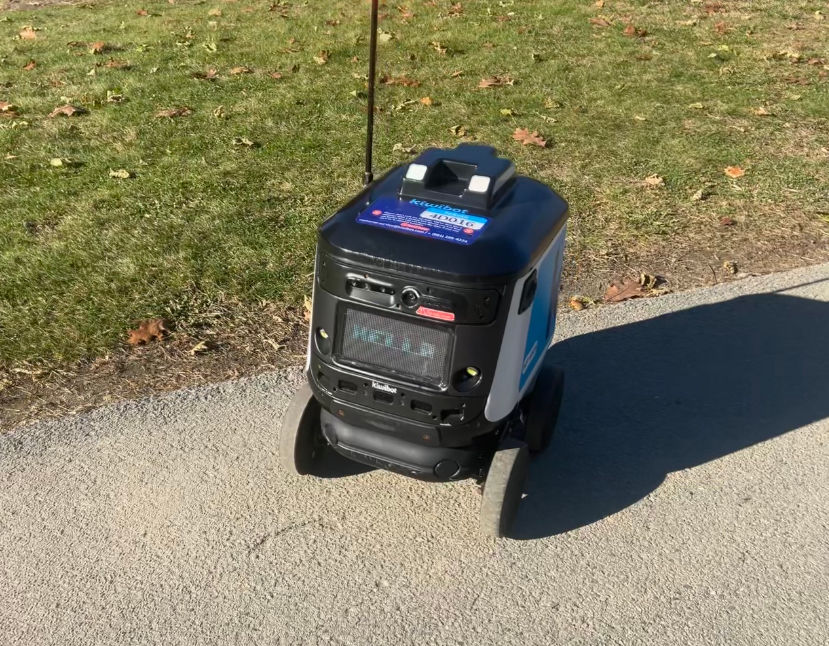
Kiwibot displaying "HELLO" message


The Kiwibots can accomplish most of their tasks autonomously and need supervision only for very specific, high-risk moments. For us, safety always prevails over efficiency. When we carry out technology developments, we always take efficiency into account, but pedestrians’ safety is our priority.


Kiwibot's high-driving automation robots use a combination of sensors and artificial intelligence to navigate through surroundings and obstacles. It also utilizes an advanced GPS navigation system with a high-tech satellite solution, to generate virtual maps and establish multiple routes that make it possible to reach a pre-defined goal.


Q: Will these services still be available come wintertime? If so, how will they navigate harsh weather conditions?


A: Our aim is to continue operating in winter. Several projects have successfully tested special tires and accessories on snowy campuses. However, given the unique conditions of UMaine's northern campus, we will evaluate bot performance and adapt as needed.


In principle the Kiwibots can operate in winter, with snow and on rainy days.  They are manufactured to cope with difficult weather and snow conditions. Their hardware is designed and tested to handle extreme weather. 


Kiwibot active amidst snow storm


Q: Do you predict a potential expansion for this technology that goes beyond food delivery?


A: Like any new concept, we must start with a specific niche, in this case food delivery. Now, we are totally open to new ideas and despite the great challenges ahead, Kiwibot's philosophy is to make robotics a visible and complementary part of our lives, not as a threat but as a tool for improving our daily experiences and quality of life.


Get in Touch

Sofia Langlois

Phone:

(518) 603- 0402

  • Twitter

Thanks for submitting!

© 2035 by NOMAD ON THE ROAD. Powered and secured by Wix

bottom of page